


Augmented Reality Children’s Books

Updated: Apr 25
How I Brought Augmented Reality to Children’s Picture Books in 2010
By David Salariya

Prologue: The Future Arrived - and Nobody Noticed
In 2010, I made children’s picture books using Augmented Reality.
Children held up a page to a computer webcam, and characters appeared on screen.
They moved, reacted, and seemed to exist in the child’s own world.
And the response?
A shrug.
Because the problem with the future is this:
It never looks important when it first arrives.
Augmented Reality - Before It Was Normal
In the last six months of 2009, I created, designed, wrote, and published two picture books that did something no children’s book in the UK had done before: they talked back.
Not through a plastic button with a microchip in the cover, but through a family’s own computer webcam – and the printed page itself.
The series was called Book, Webcam, Action!, published under my Salariya Book Company Scribblers imprint.
The two titles: Tyrone the Clean ’o’ Saurus and What Lola Wants… Lola Gets - introduced AR characters that appeared in three dimensions on screen when a child held the final page up to the webcam. "Whatever Lola Wants (Lola Gets)" is more famously known as a 1955 song from the musical Damn Yankees, famously recorded by Sarah Vaughan...but back to the Lola in my book - the story features a vain, glamorous leopard named Lola and her friend or servant, a clumsy meerkat named Monty who doesn't seem to be good at anything - until the reveal at the end when Monty is shown to be a wonderful dancer - specifically - at the tango.
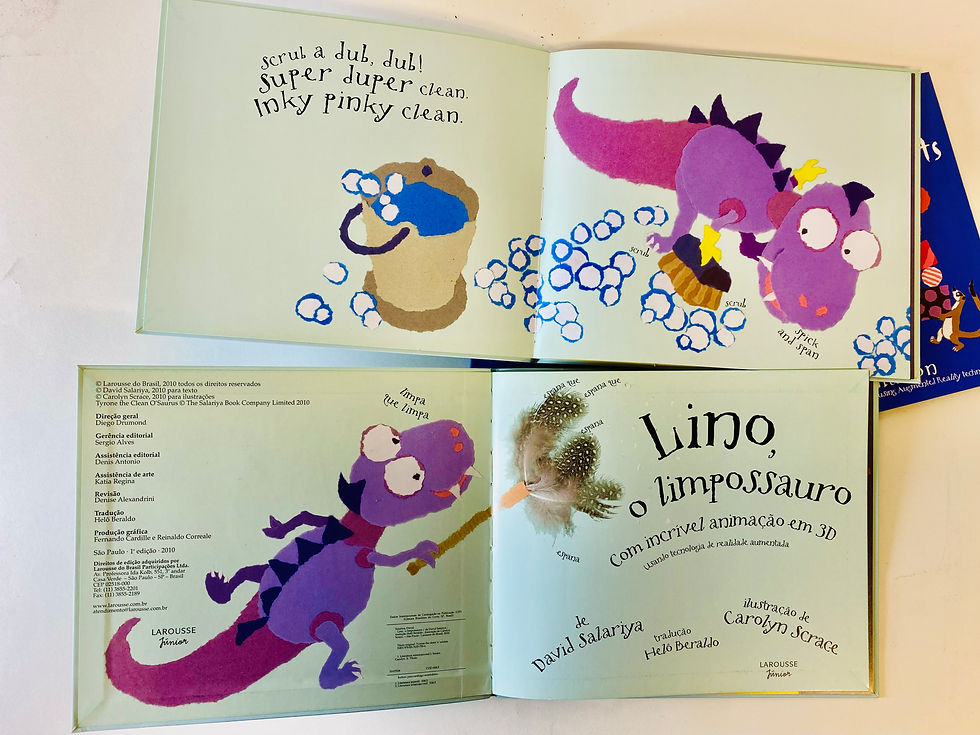
Tyrone the clean 'o' saurus, follows Tyrone, a very tidy dinosaur whose neat world is turned upside down by the arrival of a mysterious box...that contains a vacum cleaner.
The characters moved. they had music and the child could see themselves in the background – sharing the same space as a pirouetting dinosaur and a leopard and a meerkat dancing a tango.
I conceived the character of Lola the leopard as a glamorous, self-absorbed faded starwho wantedeverything to be 'purrrrrrfect' reflecting what I imagined an augmented reality star would be. Monty was seen as a well-meaning, clumsy servant eager to please. In reality, this was a not so subtle nod to Billy Wilder's film
Sunset Boulevard (1950), and the relationship between Norma Desmond and her butler, Max von Mayerling, which is a complex, co-dependent, and tragic where the butler serves as an enabler, protector, and architect of Norma's delusions, and is later revealed to be her former director and first husband. And of course the tango comes from the famous quote in that film
Valentino said, there is nothing like tile for the tango!
Norma Desmond
to Joe Gillis .Sunset Boulevard
The books were aimed at children aged two and above.
And one of the biggest problems was simple:
No one really understood how they worked.
Why Augmented Reality for Very Young Children?
By 2009, Augmented Reality was beginning to appear in consumer culture, but almost always for older audiences – tech demos, marketing campaigns, games.
My instinct at that times was that AR’s real power was not spectacle, but storytelling.
Not a gimmick - a punchline.
With hindsight, I was probably too eager to get to that punchline. A book still has to stand on its own, without the novelty layer.
But the core idea was sound.
A child holds something physical – and it directly affects what they see on screen.
Move the page - the character moves.
That connection between cause and effect is not just entertaining. It is participation.
The child is not only watching.
They are involved.
Illustration as Engineering
The success of the books depended as much on illustration as on technology.
Carolyn Scace approached the artwork in a way that was tactile and theatrical. Her illustrations were created using torn-paper collage – bold, textured, and immediate. The characters were not simply drawn. They were constructed.
That mattered, because the artwork had to do two jobs:
work beautifully on the printed page
function as a reliable trigger for the software
When we moved into AR sequences, the role of the illustrator shifted. Carolyn began to think like an animator.

She mapped out movement frame by frame, producing pencil drawings on tracing paper. These were not traditional illustrations, but blueprints for motion – gestures broken into increments, expressions evolving across a loop, and actions designed to repeat seamlessly.
Those sequences were then translated into digital animation by Leo Paper Group in China, who added colour, depth, and continuity.
Behind the scenes, Mark Williams and Rob Walker ensured that everything aligned – camera, code, image, and timing.
The illusion only worked if everything locked together perfectly.
What emerged was something new:
Part collage.Part animation.Part performance.
And it all began with paper.
The two titles were priced at £6.99 – a deliberate decision. I wanted them to feel like accessible children’s books, not premium tech toys. AR should serve the story and the child, not inflate the price tag.
The problem was that, at twenty-four pages, the books were probably not long enough to develop the story as fully as they might have done.

The Trade Press - and the Demonstration Problem
When the books were shown at the Bologna Children’s Book Fair, trade coverage noted that Scribblers was bringing AR books to the mass children’s market at a lower price point than rival publishers.
The language used at the time - “magic”, for example – reflected what happened when parents and children actually saw the books demonstrated.
That was the key difficulty.
Once people saw them, they understood them.
But selling a book that really needed a computer beside it for demonstration was another matter entirely. The sales team did not quite know how to position them, and booksellers faced the same problem. How It Actually Worked: The Technology Behind the Page
The mechanism was simpler in experience than in description – which is exactly how it should be for a toddler.
A user downloaded a short programme from the Scribblers website and linked it to the family computer’s webcam. Some editions also included the software on a CD inside the back cover.
The child – or adult – opened the book and turned to the final page.
That page featured a high-contrast illustration. The software recognised it as the trigger image.
Once the webcam locked on, a 3D animated character appeared on screen, with music playing.
As the child tilted or rotated the page in front of the camera, the character moved too.
Crucially, the live webcam feed remained visible, so the child could see themselves in the background, with the character appearing to share their space.
Each animation lasted around thirty seconds. They cost about £5,000 per book, so the concept had to work as a loop.
That is how I arrived at the tango sequence for What Lola Wants… Lola Gets!, inspired by the dance scene in Billy Wilder’s 1959 comedy Some Like It Hot.
The repetition of the music meant the sequence could continue indefinitely from different angles.
For Tyrone the Clean ’o’ Saurus, I drew on something I had noticed about young children: many of them are slightly obsessed with vacuum cleaners and cleaning. Toddlers are fascinated by buttons, switches, and the mechanics of how a hoover sucks up dust and debris.
Hoovering, with its backwards-and-forwards motion, was ideal for a loop because, as in life, it never really ends.
Retailers have long noticed this too, and many now make child-sized vacuum cleaners, including Dyson.
Why the Page Was the Controller
This last point - the child included with the character – was not incidental. It was one of the most important features of the whole system.
AR in 2010 often presented digital content as something you watched, like a television clip triggered by a barcode.
My approach was different.
The child was in the scene.
They were participant as well as audience, and they controlled the viewpoint.
The physical page was the controller. Move the page, and the character moved. Rotate it, and the character rotated.
That is what gave the experience its sense of presence and delight.
Why We Did Not Use QR Codes
The decision to use the illustration itself as the trigger – rather than a QR code or barcode – was important.
A QR code on the final spread of a children’s picture book is an alien image. It breaks the visual world of the story. It tells the child, and the parent, that this is where the real thing ends and the digital add-on begins.
We wanted the opposite.
The illustration was the trigger.
The artwork – created by Carolyn Scace in a torn-paper collage style – was designed so that the same visual choices that made it beautiful also made it trackable.
Art direction and computer vision were working together, not against each other.
The Two Books: Tyrone and Lola
Tyrone the Clean ’o’ Saurus was built around a dinosaur with an obsessive relationship with cleanliness.
When his AR character appeared on screen, he did not just spin or bounce – he pirouetted while vacuuming. That was a specific, character-driven animation choice.
The AR sequence was written as an extension of who Tyrone already was in the book, not as a generic 3D demo tagged on at the end.
That distinction matters.
AR in publishing only works when the digital moment earns its place in the story.
What I Was Really Trying to Build: AR as a Publishing Platform
Tyrone and Lola were not intended as a one-off experiment.
From the start, I was thinking about AR as a method that could extend across the list – not only in picture books, but in non-fiction too.
I had plans for future titles that would use AR to show a human heart beating, a building rising from foundations, or a historical battle unfolding – adding a new layer to the You Wouldn’t Want To Be… series.
The potential for children’s educational publishing was enormous. AR offered a way to make abstract processes visible, tangible, and interactive within a book format that parents and schools already trusted.
In today’s language, this would have been called a platform strategy – one AR engine supporting multiple books and subjects.
In 2010, that platform was a downloadable desktop programme.
What I did not anticipate was how quickly the world would shift to mobile.
Just as the books were due to be published in March 2010, Steve Jobs announced the first iPad. So even as the books were being shipped from China and the supporting website was being built, the next platform was already arriving.
Twitter (Now X)
Tyrone, Lola, and Monty were also on Twitter – now X – and were treated not simply as characters in books, but as reality stars in their own right.
The aim was to extend them beyond the printed page and give them a presence that felt immediate and alive – commenting, reacting, and gathering followers as if they genuinely existed alongside their readers.
In that sense, “reality” had nothing to do with the cosmetic theatrics we now associate with the term. It meant visibility and behaviour. These were paper characters performing themselves in public.
It was an attempt to blur the boundary between story and life – to see what might happen if a fictional creation stepped out of the book and occupied the same space as its audience.
The Structural Problem Nobody Talks About: Technology Cycles vs Book Cycles
Within a very short time of publication, tablets, smartphones, and app ecosystems changed the landscape entirely.
Holding a book up to a webcam on a desktop computer went from novel to awkward.
The webcam had moved into people’s pockets.
That was not a failure of ambition. It was simply the reality of early adoption.
When you build on a technology platform, you are always exposed to platform risk.
The download page that made the software accessible now returns an error, which means a new reader picking up a copy of Tyrone or Lola today cannot access the AR layer.
The Lesson for Modern AR Publishing
Any publisher building AR-enhanced books today should think explicitly about longevity.
Not just: how do we make this work at launch?
But: what happens in five years when the SDK updates, the app is removed, or the hosting bill goes unpaid?
The animation layer of an AR book is as much a part of the production as the printed pages. If it becomes inaccessible, a portion of the book ceases to exist.
That is a new kind of editorial responsibility, and publishing has still not fully reckoned with it.
My own problem was that we could not easily adapt the existing software or animation once the original version became outdated. To continue would have meant starting again from scratch, and I did not really want to do the same project twice – especially after a launch that had not been particularly successful in the UK.
Abroad, the technology was embraced rather differently. Spanish and Scandinavian publishers responded well to the books, and foreign editions sold strongly.
What This Experiment Taught Me
1. AR for young children works best when it is physical, not just visual
The page-as-controller model – rotate the page, rotate the character – produced something passive screen time cannot: a sense of direct authorship.
The child makes something happen.
That is the right use of AR at ages two to five.
2. The book’s visual design can be a technical asset
When the illustration is the trigger, art direction and technology become the same decision.
Strong shapes and high-contrast areas are not just aesthetically attractive – they also make tracking more robust.
That kind of co-design between visual artist and technical system is still rare in publishing, and it is worth pursuing.
3. Story-specific animation is what makes AR publishing, not AR technology
Tyrone pirouetting while vacuuming is a narrative moment, not a tech demo.
The animation was written as character, and that is what makes it memorable.
Generic AR – “watch this spin” – is quickly forgotten.
AR that extends a character’s personality becomes part of the book.
4. AR publishing needs a longevity plan from day one
Software is not a permanent material.
Any AR experience tied to a download page, an app listing, or a specific SDK version will eventually become inaccessible unless it is actively maintained or archived.
Publishers building with AR today should build in sustainability from the beginning, not treat it as an afterthought.
The Hard Commercial Lesson
The biggest problem was not creative failure.
It was economic reality.
To make these books succeed in the market would have required a level of marketing spend far beyond what a small independent business could afford.
We were not simply publishing books. We were asking the public to understand a new format, download software, and change their expectations of what a picture book could be.
That kind of audience education is expensive.
In that sense, the real comparison was never with other children’s books, but with major brand campaigns. When Calvin Klein used AR in GQ, it was supported by vast advertising budgets and an existing promotional machine.
Trying to do something similarly unfamiliar with almost no marketing budget was, in retrospect, commercially unrealistic.
The experiment was creatively right, but possibly economically naive.
Innovation alone is not enough.
If the format has to be explained before it can be bought, the cost of explanation may be greater than an independent publisher can bear.
Early, Not Wrong
The technology has moved on enormously since 2010.
But the principles that made those books work – physical energy in illustration, aesthetic integrity, story-driven design, and the child as participant rather than spectator, are still relevant.
So too is the harder lesson: new formats do not succeed on invention alone. They also need visibility, repetition, and the budget to make the public understand why they matter.
Creatively, the experiment was sound.
Commercially, it may have been madness.
But I do not think the idea was wrong.
I think it was early.

About the Author
David Salariya is a Scottish children’s publisher, author, and designer known for creating highly visual, concept-led books and exploring new formats - from early interactive digital experiments to Augmented Reality picture books.


Comments