


Haggis: A Very Peculiar History
- David Salariya
- Jan 25
- 22 min read

Updated: 6 days ago
Scotland Addresses Its Dinner

Meeting Burns on a Dundee Stage
The first time I went to the theatre that wasn’t a pantomime, was to see John Cairney in his one-man show There Was A Man at Dundee Repertory Theatre probably in 1965..
It was my first theatre trip with my parents was something serious, no jokes, no "Oh yes it is!" / "Oh no it isn't!", not safely ritualised. One man on a stage, words, a presence.
John Cairney’s Burns was intense, physical, long, very long.., he filled the stage. And he was dressed - at least as I remember it - like a poet ought to be dressed: jabot from the neck, dark-coated. In my mind, I filed him alongside Lord Byron.
I assumed Burns and Byron belonged to the same generation.
Of course they did not.
Byron was eight years old when Burns died. Burns never lived in the post-Revolutionary, high-Romantic world that Byron came to embody. He belonged to the late Enlightenment: a world of tenant farms, kirk discipline, debt, illness, argument, and song.
Chronologically, socially, politically, they were separated by a fault line.
And yet - crucially - my mistake was not accidental.
Cairney was not dressing Burns as Burns dressed. He was dressing Burns as posterity learned to imagine poets. The Byronic silhouette - the sense of the poet as a dangerous, bad and mad - had been retrofitted backwards. Through theatre, memory, and repetition, Burns had been visually absorbed into a Romantic tradition that post-dated him.
That is how culture works. It edits. It compresses. It supplies costumes.
Which brings us, oddly but inevitably, to haggis.
For all the theatrical mediation, for all the later tartanry and poetic myth-making, the centre of Burns Night is not an image but a thing. A heavy, steaming, inconvenient puddin. A sheep’s stomach filled with chopped offal, oats, and spices. It must be carried, announced, addressed, stabbed, and eaten.
Burns did not design the Burns Supper, but the ritual that grew around him contains an accidental wisdom. It allows poetry, performance, and ceremony - but anchors them to something stubbornly physical. You can dress Burns up as Byron if you like. You can monumentalise him, sanitise him, or market him.
But when the haggis arrives, abstraction ends.
You cannot sentimentalise over a dish that must be cut open in public.
Looking back, I realise that my first Burns - Cairney’s Burns - prepared me for that contradiction. Theatre gave me the poet as presence; haggis returns him to material reality. One pulls him towards myth. The other drags him back to appetite, class, and consequence.
Writing in the shadow of the French Revolution, Robert Burns lived through - and responded to - one of the most politically volatile periods in modern European history.
He died in 1796, seven years after the Revolution began, and his most overtly political song, Scots Wha Hae (1793), was composed at the very moment when events in France had radicalised following the execution of Louis XVI. Ostensibly a speech by Robert the Bruce before Bannockburn, the poem uses historical allegory to explore contemporary ideas of popular sovereignty, resistance to tyranny, and moral commitment unto death. The climactic phrase “Let us do - or die!” would have resonated strongly with readers familiar with the revolutionary rhetoric of 1789, particularly the spirit of the Tennis Court Oath, in which French deputies pledged unwavering resolve against royal authority. Unlike many British sympathisers who retreated as the Revolution turned violent, Burns continued to express radical sympathies - albeit increasingly through coded, historical forms - placing him not merely as a passive observer but as a poet deeply engaged with the revolutionary imagination of his age.
Which is why, every January, Scotland does not simply recite Burns.
It feeds him to itself.
Haggis: A Very Peculiar History...
Every culture announces power with noise.
Some do it with trumpets. Others with drums. Modern states prefer orchestration, uniforms, and carefully choreographed pauses designed to remind the room who has entered.
Scotland, of course, does it with a pudding.
When a haggis is carried into a Burns Supper, it is not brought in. It is received. The bagpipes precede it. The room stands. A knife is drawn. Words are spoken that elevates a stuffed sheep’s stomach to the status of leadership.
Great chieftain o’ the pudding-race!
With this line, Robert Burns performs a remarkable sleight of hand. He does not merely praise a dish; he confers rank. The haggis is not metaphorically important - it is ceremonially so. It arrives with all the trappings of authority: sound, spectacle, and a waiting audience.
It is, in other words, greeted exactly as power likes to be greeted.
In the United States, the entrance of the President is marked by Hail to the Chief - an anthem formally adopted in 1954, prefaced by four Ruffles and Flourishes, and performed with military precision. The music announces nothing about policy, wisdom, or restraint. It announces presence. The Chief is here.
Some presidents have treated this ritual lightly. Others - Donald Trump, most conspicuously - have appeared to relish it. The standing audience. The repetition. The confirmation that the room knows who has arrived.
Power, when insecure, enjoys a soundtrack.
The connection to Scotland is not incidental. Hail to the Chief itself is adapted from a Scottish melody arranged by James Sanderson, inspired by Sir Walter Scott’s The Lady of the Lake. Before it became a fixture of American executive ceremony, it was steeped in Highland romanticism - chiefs, clans, inherited authority rendered safe through distance and verse.
Burns, however, goes somewhere more dangerous.
Where presidential anthems elevate individuals, Burns elevates a thing. Where modern ceremony creates distance, Burns insists on proximity. Where power demands reverence,
Burns demands appetite.
The haggis must be cut open. Its contents revealed. It must be shared, chewed, digested. Authority, in Burns’s hands, ends not in applause but in digestion.
This is not accidental. It is satire disguised as celebration.
Burns does not reject ceremony; he redirects it. He allows Scotland its pageantry, but anchors it to something stubbornly material, grotesque, and impossible to sentimentalise. The haggis resists abstraction. It refuses to be merely symbolic. It smells. It steams. It looks exactly like what it is.
And that is why haggis - rather than whisky, tartan, or poetry itself - sits at the centre of Burns Night. It keeps the ritual honest. It prevents the poet from becoming embalmed.
What followed was one of the strangest cultural manoeuvres in European history: a nation chose to commemorate its greatest poet not with statues alone, but with a recurring meal; not with silence, but with recitation; not with distance, but with a dish that must be physically opened in public.
This is not culinary nostalgia. It is cultural engineering.
The Burns Supper did not simply preserve Robert Burns. It preserved a way of thinking about authority, class, and value - one in which ceremony is allowed, but only if it ends at the table.
That a modern superpower announces its leader with a borrowed Highland tune while Scotland announces a pudding with a poem is not coincidence.
It is contrast.
And it is, in the best sense, a very peculiar history.
On 25 January, across village halls, embassies, pubs, universities, oil rigs, cruise ships and carefully booked restaurants, a dish made of sheep’s innards is carried in as though it were a visiting head of state. It is piped, applauded, addressed in verse, ceremonially cut open, toasted with whisky, and eaten with earnest seriousness.
This is the story of how haggis, once a practical, almost disposable food, became the symbolic centre of Scotland’s most enduring literary ritual. It is, unavoidably, a very peculiar history. I have to admit although born in Scotland I didn't eat haggis very often, once a year in my late teens - Burns suppers were good to fill the miserable dark January after Christmas. I am sure all these ideas of Scottishness were reinforced when Mel Gibson cried "Freedom'...even the Massai I met in Kenya knew 'Braveheart'.
Before Burns: The Long, Unromantic Life of Stuffed Stomachs
Haggis did not begin its life in poetry.
It began, like most foods, in hunger, efficiency, and the grim reality that once an animal is dead, you need to do something with it quickly.
Long before Scotland appears in the record, the idea of chopping organs, seasoning them, and cooking them inside a stomach was already old. Ancient Greece knew it. Rome perfected it. Northern Europe depended on it.
In Homer’s Odyssey (the poet that is, not Bart's dad), a man turning a stomach filled with fat and blood over a fire is compared to a cook impatiently waiting for his meal. It is not called haggis - but any Scottish reader might recognise this as a black pudding...or again "puddin'.
Ancient Roman soldiers, too, were practical eaters. They needed quick, nourishing food that could be cooked fast and waste nothing. Chopped offal, grain, herbs, and blood cooked in a casing was efficient, durable, and sustaining.
The point worth making, quietly, and without nationalist anxiety, is this:
Scotland did not invent the idea of haggis.
What Scotland did was keep it, refine it, and eventually elevate it.
Medieval Britain: When Haggis Wasn’t Scottish (Yet)
The earliest written recipes for something recognisably like haggis appear not in Scotland, but in medieval England.
A 15th-century recipe known as Hagws describes sheep’s organs parboiled, chopped, mixed with bread, eggs and spices, then stuffed into the animal’s stomach and boiled. The word haggis appears in dictionaries by the mid-1400s, defined plainly as a pudding.
This is important, because it undermines a comforting myth: that haggis was always uniquely Scottish.
It wasn’t.
For centuries it was poor people’s food across Britain, especially in sheep-raising regions. It was cheap, filling, warming, and, crucially, made from bits that gentile society preferred not to see anywhere near the table.
Scotland’s role in the story begins not with invention, but with association. Haggis survived longer there, remained more visible, and, thanks to geography, economics, and class, became culturally sticky.
And then, in the late 18th century, it met the one man capable of rewriting its destiny.
Burns Enters the Dining Room via the Kitchen
By the time Robert Burns wrote Address to a Haggis in 1786, haggis had acquired a reputation, particularly in England, as a symbol of Scottish backwardness.
English writers mocked it. Samuel Johnson sneered at oats. Tobias Smollett recoiled from the idea of eating haggis at all. Scottish food, in metropolitan eyes, was grey/beige coarse, rustic, with a whiff of embarrassment.
Burns’s response was not defensive.It was theatrical.
Fair fa’ your honest, sonsie face, Great chieftain o’ the pudding-race!
With these opening lines, Burns does something audacious: he crowns a peasant dish as nobility. The haggis is no longer an object of apology. It is a chieftain.
The poem is comic, muscular, gleefully overblown. Burns contrasts haggis with delicate foreign cuisine - “ragouts” and “fricassees” - which he portrays as weakening the men who eat them. Haggis, by contrast, feeds strength, labour, courage.
This is not really about food.
It is about dignity.
Burns takes what has been laughed at and turns it into a banner. He does not claim refinement; he claims worth. And in doing so, he gives Scotland something invaluable: a way to be proud without pretending to be fashionable.
The First Burns Supper (Not on His Birthday)
One of the quieter ironies of Burns Night is that the first Burns Supper was not held on 25 January at all.
It took place on 21 July 1801, five years after Burns’s death, organised by friends at Burns Cottage in Alloway. It was a memorial meal: haggis, whisky, readings, songs, conversation.
Only later was the date shifted to Burns’s birthday, transforming a private remembrance into a public ritual.
This matters, because it reveals the Burns Supper not as something Burns designed, but something Scotland constructed - carefully, communally, and with remarkable consistency.
What began as a meal became a script.
How the Burns Supper Became Theatre
The modern Burns Supper is, at heart, a piece of performance art.
There is an order. A structure. A choreography.
The piping in of the haggis The recitation of Address to a Haggis The ceremonial stabbing. The whisky toast The Immortal Memory The speeches, the songs, the laughter
This is not accidental. It is ritualised repetition - the thing that turns culture into tradition.
And at its centre remains the haggis: physical, pungent, unavoidable.
Unlike statues or plaques, you must engage with it. You must smell it. Cut it. Eat it. Digest it.
Burns is not honoured from a distance. He is honoured at the table.
Why Haggis Works (And Nothing Else Would)
It is worth asking why haggis - and not, say, oatcakes or whisky - became the symbolic core of Burns Night.
The answer is that haggis is inconvenient.
It refuses elegance, even in that stacking arrangement adored by restaurants. It resists sanitisation. It looks like what it is.
That makes it perfect.
Haggis embodies the values Burns championed:
labour over polish
honesty over ornament
substance over display
It is democratic food. Shared food. Unpretentious food.
And crucially, it carries class memory.
Burns wrote for ordinary people. Haggis fed them.
Tartanalia
All of this ceremony - the piping, the standing, the elevation of a puddin - can easily be mistaken for timeless Scottish tradition: kilts, speeches, set forms. It encourages the comforting illusion that Burns Night is simply another expression of an ancient, tartan-wrapped past.
It isn’t.
And it is worth remembering that Robert Burns would not have recognised most of what now accompanies his name.
Burns did not inhabit a world of clan tartans, souvenir shortbread tins, or packaged authenticity. The visual grammar of modern “Scottishness”- regulated setts, colour-coded identity, ceremonial costume - is largely a 19th-century construction, assembled after his death and enthusiastically reinforced thereafter.
Burns wore ordinary clothes. He moved between farm labour, taverns, drawing rooms, and political argument. His Scotland was linguistically volatile, socially divided, and economically pressured. It was not curated. It was not picturesque.
And it was certainly not merchandised.
To wrap Burns in tartan is to blunt him. He was not a mascot. He was ironic, abrasive, alert to class and power. His poems are not decorative expressions of national character; they are interventions - sometimes comic, sometimes furious - into how people live and are judged.
Burns Night Goes Global
By the mid-19th century, Burns Suppers were being held across the world: London, Canada, the United States, Australia, New Zealand. By the mid 20th Century Burns was famous in the USSR, poems like A Man’s a Man for a’ That were read as proto-socialist statements - attacks on inherited privilege and celebrations of human dignity grounded in labour rather than rank.
Burns in the USSR was presented as:
a working man
a farmer-poet
an enemy of aristocratic pretension
This fitted the Soviet narrative perfectly.
And of couse the Scottish diaspora carried not just Burns’s poems, but the ritual itself. Wherever Scots gathered, they recreated the ceremony. The script held.
Few literary cultures have exported a poet in quite this way - through a meal.
Burns Night became less about nostalgia and more about continuity: a way of being Scottish without needing permission.
A Very Peculiar History Indeed
Haggis is ancient. Burns is modern. The Burns Supper sits between them like a hinge.
What makes this story remarkable is not that Scotland celebrates a poet with food - but that it chose the least glamorous food available and refused to apologise for it.
There is no attempt to refine haggis into something it isn’t. Vegetarian (Macsween Vegetarian Haggis - probably the best) versions aside (a concession Burns might have enjoyed mocking), the dish remains stubbornly itself.
And so does the ritual.
Each year, the same poem is recited.
The same knife is raised.
The same lines are spoken.
And still it works.
That is culture doing its job.
The Chieftain Endures
Burns did not invent haggis. He did something more powerful.
He taught a nation how to look at it.
And in doing so, he helped Scotland learn how to look at itself - without embarrassment, without deference, without pretending to be something else.
The haggis is not elevated despite being ordinary.It is elevated because it is.
On 25 January, when the pipes start and the pudding arrives, Scotland does not simply remember a poet.
It eats its history.
Address to a Haggis
Robert Burns
English Translation
Fair fa’ your honest, sonsie face,Great Chieftain o’ the Puddin-race!Aboon them a’ ye tak your place, Painch, tripe, or thairm:Weel are ye wordy of a graceAs lang ‘s my arm.
Translation: Good luck to your honest, hearty face, Great leader of all puddings! You stand above them all - stomach, tripe, or intestines.You are truly worthy of a long and generous blessing before a meal.
The groaning trencher there ye fill,Your hurdies like a distant hill,Your pin wad help to mend a millIn time o’ need,While thro’ your pores the dews distilLike amber bead.
Translation: You fill the serving dish until it groans under the weight.Your rounded sides rise like a distant hill.Your skewer (pin) could fix a broken mill if needed, while rich juices seep through your skin like drops of amber.
His knife see Rustic-labour dight,An’ cut ye up wi’ ready slight,Trenching your gushing entrails bright,Like onie ditch;And then, O what a glorious sight,Warm-reekin, rich!
Translation: See the hardworking farmer wipe his knife, then slice you open with practiced skill,cutting through your bright, spilling insides like digging a trench;and then - what a magnificent sight - steaming hot and rich!
Then, horn for horn, they stretch an’ strive:Deil tak the hindmost, on they drive,Till a’ their weel-swall’d kytes belyveAre bent like drums;Then auld Guidman, maist like to rive, Bethankit hums.
Translation: Then spoonful by spoonful they compete,“Devil take the slowest!” they cry, until their well-filled bellies are stretched tight like drums. Then the old master of the house, nearly bursting, hums a thankful prayer.
Is there that owre his French ragout, Or olio that wad staw a sow,Or fricassee wad mak her spew Wi’ perfect sconner, Looks down wi’ sneering, scornfu’ view On sic a dinner?
Translation:Is there anyone - hovering over French stew,or fancy mixed dishes that wouldn’t even satisfy a pig,or delicate fricassees that would make her sickwith disgust - who looks down with sneering contempton a meal like this?
Poor devil! see him owre his trash, As feckless as a wither’d rash,His spindle shank a guid whip-lash,His nieve a nit;Thro’ bluidy flood or field to dash,O how unfit!
Translation: Poor wretch! Look at him over his rubbish food - weak as a dried-out twig, his thin legs like a whip handle, his fist no bigger than a nut. To charge through bloody battle or rough ground?Completely unfit!
But mark the Rustic, haggis-fed,The trembling earth resounds his tread, Clap in his walie nieve a blade,He’ll make it whissle; An’ legs, an’ arms, an’ heads will sned,Like taps o’ thrissle.
Translation: But look at the haggis-fed countryman:the ground shakes beneath his step.Put a sword in his strong hand and he’ll make it whistle; legs, arms, and heads will be cut downlike the tops of thistles.
Ye Pow’rs wha mak mankind your care,And dish them out their bill o’ fare,Auld Scotland wants nae skinking wareThat jaups in luggies;But if ye wish her gratefu’ prayer,Gie her a Haggis!
Translation: You Powers who watch over humankind and decide what food they are given,Old Scotland doesn’t want watery rubbish sloshing around in bowls. But if you want her heartfelt thanks, give her a haggis!
From The Complete Poems and Songs of Robert Burns First printed in The Caledonian Mercury in 1786
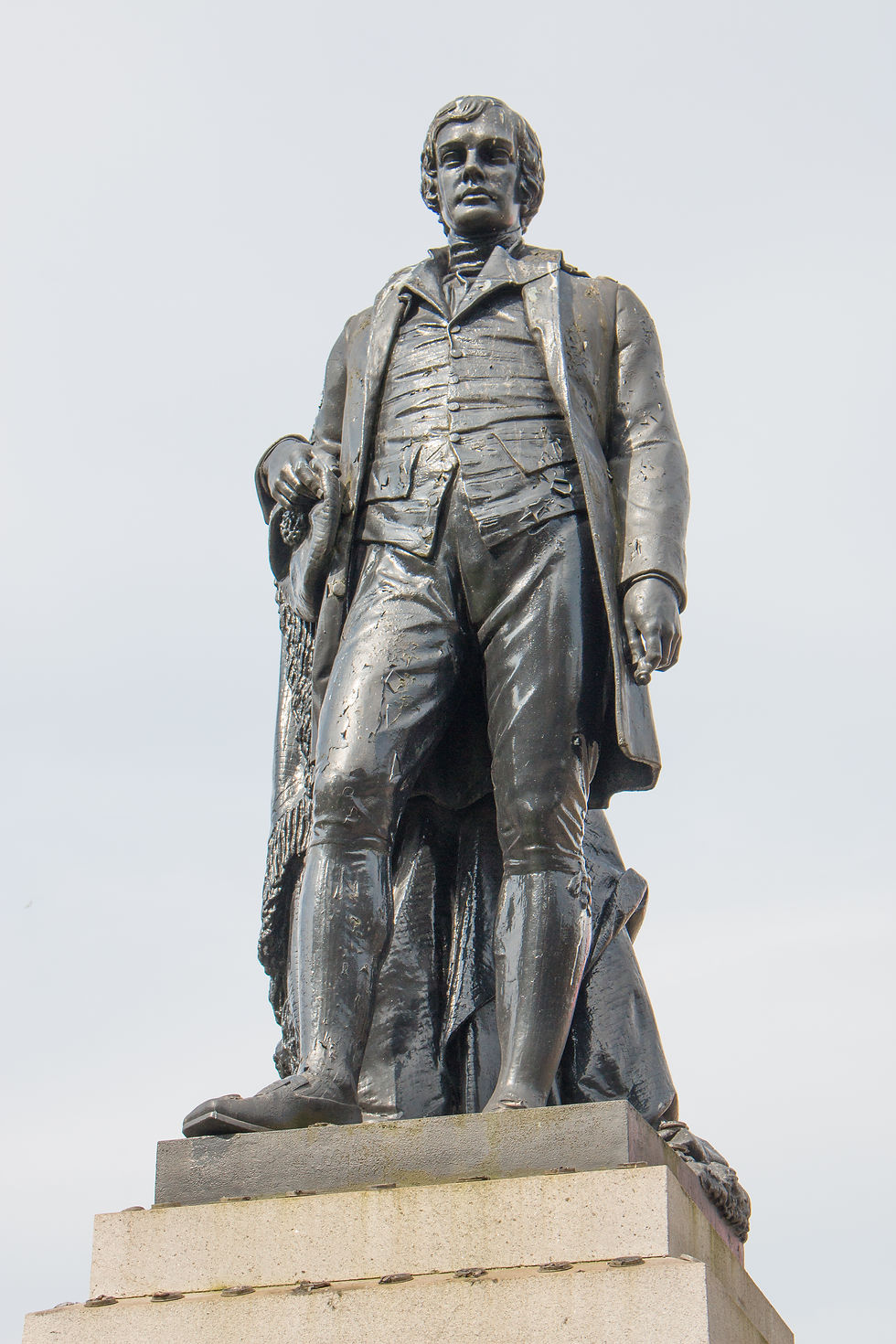
Robert Burns: Genius, Appetite, Damage
A Life Lived at Full Pressure
Robert Burns was born on 25 January 1759 in a two-room cottage in Alloway, Ayrshire, built by his father. William Burnes (later Burns) was a struggling tenant farmer, proud, principled, and chronically unlucky. From the start, Burns’s life was marked by labour, precarity, and strain - physical and financial. This was not a childhood of pastoral ease. It was a childhood of back-breaking work, intermittent schooling,
and the constant pressure of debt.
Burns was clearly clever. His father ensured that he and his siblings were educated beyond their class, hiring tutors when possible and insisting on reading, discussion, and moral seriousness. This combination - intellectual ambition inside economic limitation -never left him. It produced both his genius and his restlessness.
Work and the Body
Farm labour damaged Burns young. Heavy work, hunger, exposure, and exhaustion left him prone to illness throughout his life. He suffered from recurring bouts of rheumatism, fevers, chest complaints, and depression. Doctors retrospectively have suggested rheumatic heart disease, possibly triggered by untreated streptococcal infections, as an underlying condition.
There is no proof that Robert Burns had chronic alcoholism or venereal disease.
Rheumatic heart disease (RHD
Rheumatic heart disease (RHD) is a serious, long-term condition caused by damage to the heart valves — most commonly the mitral or aortic valves. This damage develops as a delayed consequence of one or more episodes of acute rheumatic fever (ARF).
Acute rheumatic fever is triggered by an autoimmune inflammatory response following untreated streptococcal infections, such as strep throat or scarlet fever. Instead of resolving cleanly, the body’s immune response mistakenly attacks its own tissues, including the heart.
Valve damage from RHD develops gradually, often over many years. As the valves become scarred or deformed, the heart must work harder to pump blood efficiently. Common symptoms include chronic fatigue, shortness of breath, chest pain, heart palpitations, swelling, and recurrent episodes of illness or fever.
Today, treatment focuses on:
antibiotics to prevent or control streptococcal infection
medication to manage cardiac symptoms
and, in severe cases, surgical repair or replacement of damaged valves
Before the advent of antibiotics and modern cardiology, the condition was poorly understood, untreatable, and frequently fatal, particularly when compounded by physical labour, repeated infections, and ineffective medical interventions.
Burns lived in a world without antibiotics, pain relief, or effective treatments. Illness was managed with bleeding, purging, alcohol, opiates, and hope.
None of these helped.
The Drink (Yes) - But Not the Whole Story
Burns drank. This is undeniable. Taverns were social spaces, political spaces, literary spaces. Drink lubricated conversation and performance. Burns enjoyed it, sometimes relied on it, sometimes overdid it.
But he was not the constant drunk of caricature.
He worked hard, wrote obsessively, corresponded endlessly, and held down employment. Drink exacerbated his health problems; it did not create them. Burns drank like many men of his time - but he suffered more visibly because his body was already compromised.
Women, Sex, and Consequences
Burns’s emotional and sexual life was intense, generous, irresponsible, and complicated.
He loved women. He wrote to them brilliantly. He slept with them enthusiastically. He fathered at least twelve children by four women, possibly more?
His relationships were not uniformly callous. He could be tender, devoted, and sincere. But he could also be reckless, self-absorbed, and optimistic to the point of denial. He did not always provide materially as he should have, often because he simply could not.
Jean Armour, the woman most associated with Burns, bore him nine children, only three of whom survived infancy. Their relationship was long, fraught, loving, humiliating, and binding. Burns did not always behave well. Jean endured public shame, parental hostility, and financial instability. She also understood Burns better than most and remained with him until his death.
Burns’s sexual life was not scandalous by modern standards - but the consequences were far harsher. Pregnancy was dangerous. Infant mortality was high. Reputation mattered.
Women paid more than men.
Burns knew this, and his letters show guilt, anxiety, and self-criticism alongside desire.
Poetry and Work: Not Separate Things
Burns did not write in leisure.
He wrote while working, often exhausted. He composed while farming, excise riding, courting, drinking, worrying, and being ill. His poetry is rooted in speech, song, insult, praise, and politics. It is not the product of withdrawal, but of immersion.
“A Man’s a Man for a’ That” is often quoted as a comforting slogan of equality. It is not comfort. It is argument.
Burns believed in dignity, not purity. Equality, not perfection. He distrusted inherited authority, mocked false refinement, and valued intelligence wherever it appeared. His politics were shaped by the American and French Revolutions, and his sympathy for radical causes put him under surveillance. He was no naïve nationalist. He was internationalist in instinct, local in loyalty.
The Plantation Question (Uncomfortable)
Burns’s relationship to slavery and empire is complicated and uncomfortable - and must be faced .
Early in his life, Burns seriously considered taking a job as a bookkeeper on a Jamaican plantation, likely one worked by enslaved people. He was desperate, indebted, and facing social disgrace. The job offer was real.
That he did not go was largely due to the sudden success of his poetry, not moral awakening.
Burns did, however, express explicit anti-slavery sentiments later, notably in poems and letters condemning human bondage. Like many of his contemporaries, he lived inside a system he partially resisted and partially benefited from. He was not enlightened by modern standards. He was, however, capable of moral movement - which matters.
Illness, Doctors, and Death (The Byron Parallel)
By the mid-1790s, Burns was visibly failing.
He suffered from chronic pain, fevers, weakness, swelling, and exhaustion. His heart was likely damaged. His immune system compromised. He continued to work as an excise officer, riding long distances in all weather, worsening his condition.
Doctors treated him with bleeding, blistering, mercury compounds, and alcohol. These were standard treatments. They almost certainly hastened his decline.
So - like Lord Byron 28 years later in 1824, Burns was, in effect, killed by medical practice as much as by disease. The difference is that Byron died young in public heroics; Burns died young in debt, pain, and obscurity.
Burns died on 21 July 1796, aged 37. His last child was born on the day of his funeral.
Afterlife: Sanitised, Packaged, Resisted
Burns did not design Burns Night.
He did not invent the tartanfest. He did not imagine his face on shortbread tins or plates.
That came later.
What endured was not his virtue, but his voice. Not his respectability, but his recognisability.
Burns survives because he wrote about appetite, inequality, hypocrisy, sex, work, love, anger, and joy without pretending to be pure. He believed dignity was not earned by manners, but by humanity.
He was not perfect.
That is the point.
A man’s a man for a’ that.
Burns did not offer salvation.He offered recognition.
The Publishing Life of Robert Burns
How a Tenant Farmer Became Scotland’s Best-Selling Poet
Robert Burns did not emerge from patronage, university networks, or polite literary salons. He entered print out of desperation, not ambition - and his success came through a chain of small, risky publishing decisions rather than a single grand endorsement.
The Context: Why Burns Needed Publishing
By the mid-1780s Burns was:
bankrupt as a farmer,
socially compromised by illegitimate children,
physically exhausted,
and seriously considering emigrating to Jamaica to work as a plantation bookkeeper.
Publishing was not a career plan.It was an escape route.
Burns needed money quickly - enough to fund passage overseas and settle debts. Printing his poems was a last roll of the dice.
The Kilmarnock Edition (1786): Burns’s Big Break
Burns’s breakthrough came not in Edinburgh or London, but in Kilmarnock, through a local subscription publication - the 18th-century equivalent of crowdfunding.
Publisher
John Wilson, printer in Kilmarnock
Book
Poems, Chiefly in the Scottish Dialect (1786)
Print run: 612 copies
Format: modest octavo
Price: 3 shillings
Sold largely by advance subscription
Burns financed the printing himself, with subscribers paying upfront. This reduced the printer’s risk and gave Burns control over content - crucial, given the political and sexual frankness of the poems.
The book sold out rapidly.
It made Burns famous in Ayrshire almost overnight.
More importantly, it made him visible to Edinburgh.
Why the Kilmarnock Edition Worked
Language Burns wrote unapologetically in Scots, not “polite” English. This marked him as authentic rather than provincial.
Tone The poems were funny, sharp, political, erotic, and recognisably spoken rather than literary.
Timing Scotland was primed for a figure who felt native rather than imported. Burns arrived at exactly the right moment.
This was not luck. It was cultural fit.
Edinburgh Edition (1787): Fame, Patronage, and Loss of Control
Encouraged by the success of the Kilmarnock edition, Burns travelled to Edinburgh in late 1786. There he was received not as a curiosity, but as a phenomenon.
Publishers
William Creech (bookseller and publisher)
Book
Poems, Chiefly in the Scottish Dialect (Edinburgh Edition, 1787)
This edition:
expanded the text,
added notes and glosses,
and was marketed to a polite, urban audience.
Burns was feted by lawyers, professors, aristocrats, and Enlightenment figures. Portraits were commissioned. Dinners were held. He was admired - but also subtly reshaped.
This is where publishing tension enters the story.
Burns earned far less from the Edinburgh edition than its prestige might suggest. Creech was cautious, slow to pay, and increasingly controlling. Burns, unused to contracts and leverage, was outmanoeuvred.
The pattern is familiar.
Songs, Editors, and Fragmented Authorship
After Edinburgh, Burns did not produce another major poetry volume.
Instead, he poured energy into song collecting and rewriting, contributing hundreds of lyrics to projects like:
The Scots Musical Museum
A Select Collection of Original Scottish Airs
These were collaborative, editorial projects - often unpaid or poorly paid. Burns believed he was preserving national culture. In publishing terms, he was giving away IP.
Editors and publishers benefited long-term. Burns did not.
London Never Quite Happened
Unlike later poets, Burns never properly cracked London.
Why?
His Scots language was seen as regional.
His politics were suspect.
His refusal to flatter patrons made him unreliable.
He was admired - but not fully assimilated.
In modern terms, Burns became a national author without becoming a metropolitan one.
Posthumous Publishing: Where the
Real Money Was Made
Burns’s real publishing success happened after his death.
Editions multiplied rapidly.
Editors sanitised, rearranged, and moralised his work.
Burns Clubs and memorial volumes drove steady sales.
His image was slowly domesticated.
By the mid-19th century, Burns was institutional property.
Ironically, the poet who distrusted authority became a pillar of it.
Why Burns’s Publishing Story Matters
Burns’s career shows:
how regional publishing can launch global influence,
how subscription models reduce risk,
how authors lose control when fame accelerates faster than contracts,
and how posthumous branding can overwrite lived reality.
He did not rise through the system. He slipped through a crack in it.
And the crack closed behind him.
In Short: Burns’s Big Break
1786: Self-funded Kilmarnock edition - local fame
1787: Edinburgh edition via William Creech - national recognition
Afterwards: Songs, collaborations, underpaid labour
After death: Massive expansion of reputation and revenue - mostly for others
Burns became Scotland’s national poet not because the publishing industry planned it, but because it couldn’t quite contain him.
Robert Burns’s Family After His Death: What Really Happened
When Robert Burns died in 1796, aged just thirty-seven, he left behind more than poems. He left a complicated family structure, fragile finances, and a reputation that was already growing faster than the security of those closest to him.
Burns fathered at least twelve children by four women. This was not unusual in an age before reliable contraception, but the consequences were severe, particularly for the women involved. Infant mortality was high. Social protection was minimal. Literary fame offered no automatic safety net.
Children with Jean Armour
Burns’s wife, Jean Armour, bore him nine children. Of these, only three survived into adulthood - a brutal but historically typical outcome.
The surviving children were:
Robert Burns Jr. (1789–1857) Entered government service, working in the Stamp Office in London. His life was respectable rather than distinguished - steady employment rather than inherited genius.
William Nicol Burns (1791–1872) Served with the East India Company, eventually achieving senior administrative rank. (He is often incorrectly described as a lieutenant colonel; he was an officer, but not a celebrated military commander.)
James Glencairn Burns (1794–1865) Also worked in India under Company administration. Like his brother, he benefited from imperial opportunity rather than literary inheritance.
Other children with Jean - Jean, Francis, and Maxwell - died in infancy or early childhood. Maxwell, poignantly, was born on the day of Burns’s funeral.
Jean Armour herself did not benefit directly from Burns’s posthumous fame. She survived through a combination of subscriptions, modest pensions, and practical resilience, raising children and managing with care rather than comfort. Importantly, she also took responsibility for one of Burns’s illegitimate children, an act of quiet generosity rarely foregrounded in Burns mythology.
Children from Other Relationships
Burns’s illegitimate children are often treated as footnotes. In reality, they are central to understanding the human cost of his life.
Elizabeth “Bess” Burns (1785–1817) Daughter of Elizabeth Paton. Raised by Burns’s mother and brother. She later married a farmer and lived an unremarkable, working life. She did not benefit materially from her father’s reputation.
Elizabeth “Betty” Burns (1791–1873) Daughter of Anna Park. Taken in and raised by Jean Armour. Through Betty’s descendants, much of Burns’s modern genealogical line continues.
Robert Clow (1788) Son of Jenny Clow. He did not survive long enough to leave a significant record.
Did Burns’s Publishing Success Secure His Family?
This is where popular accounts often overstate the case.
It is true that posthumous editions of Burns’s work were published quickly and sold well. It is also true that subscriptions and public appeals were raised in the immediate aftermath of his death.
What is not true is that Burns’s children inherited literary wealth.
Copyright law was weak.
Burns had sold much of his work outright.
Song lyrics earned little or nothing.
Editors and publishers benefited far more than heirs.
Burns’s surviving sons were able to pursue careers - particularly in India - not because they inherited money, but because imperial structures offered opportunity to men of modest means with name recognition. That recognition opened doors; it did not fund lives.
Jean Armour’s security came from pension and charity, not publishing royalties.
Descendants and the Long Tail of Fame
Burns now has hundreds - possibly thousands - of descendants worldwide, many traced through Elizabeth “Betty” Burns and her granddaughter Sarah Elizabeth Maitland Tombs Burns. These descendants include soldiers, teachers, merchants, emigrants, and professionals spread across generations and continents.
What links them is not wealth, but association.
Burns’s name endured.His income did not.
The Editorial Reality
Burns’s family story exposes an uncomfortable truth about literary afterlives:
Reputation grows faster than responsibility
Commemoration replaces care
Publishing systems reward texts, not dependants
By the time Burns became a national institution - Burns Suppers, monuments, schoolroom quotations - his children were already adults making ordinary lives under extraordinary shadows.
The poet was immortalised.The family was managed.
That imbalance is not unique to Burns.But it is especially visible in his case, because he wrote so powerfully about equality, dignity, and human worth.
A man’s a man for a’ that.
Burns believed it. His family lived the test of it.
Burns acknowledged that the popular farewell song, Auld Lang Syne, was not entirely his own creation. Although there were other versions, his rendition is the one most commonly sung today.
Auld Lang Syne


Comments